House Demolitions as a Punishment for Religious Minorities
 admin
adminOverview
In recent years, house demolitions have emerged as a troubling form of punishment directed at minority communities in India—particularly Muslims—often following communal incidents or protests. Human rights bodies including Amnesty International and Human Rights Watch have documented these demolitions as instances of collective punishment, conducted without due process and in violation of both national and international legal standards.
A Pattern of Targeted Punishment
Between April and June 2022, Amnesty International documented demolitions across five states:
Assam
Gujarat
Madhya Pradesh
Uttar Pradesh
Delhi (AAP-led)
Their investigation established that demolitions were routinely ordered immediately after episodes of communal tension, framing them as retaliation rather than legitimate urban planning or legal enforcement.
Amnesty examined 63 cases in depth, interviewing over 100 affected individuals, lawyers, journalists, and community workers. Their findings revealed:
617+ people displaced, including families with children and elderly persons
Homes, shops, and small businesses destroyed
Forced evictions without notice or legal recourse
Use of intimidation, excessive police force, and public humiliation
Denial of fair trial rights, housing rights, and non-discrimination guarantees
These actions, Amnesty concluded, amount to collective and arbitrary punishment, not lawful enforcement.
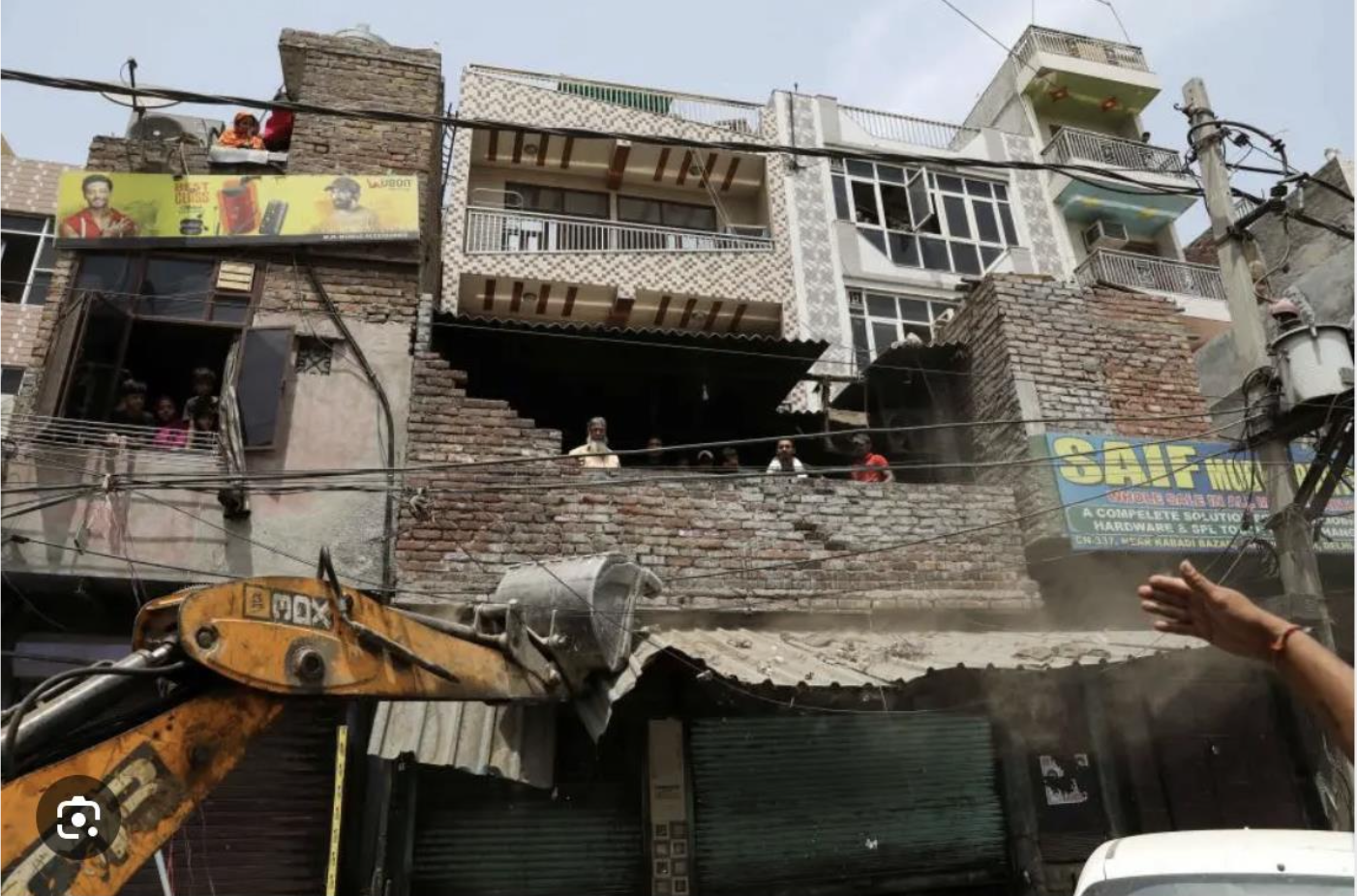
JCB Bulldozers and the Symbolism of “Bulldozer Justice”
Amnesty’s Digital Verification Corps confirmed that JCB machinery—although not the only type used—was the most frequently deployed.
This repeated use created a dangerous cultural symbol:
JCB bulldozers were celebrated publicly on social media
Right-wing outlets referred to them as “Jihadi Control Board”
Bulldozers were paraded in rallies as tools of intimidation
While JCB stated that it cannot control how purchased machines are used, international business and human-rights standards disagree. Under UN Guiding Principles on Business and Human Rights, companies must ensure that their products are not directly linked to human rights abuses.
Agnès Callamard, Secretary-General of Amnesty International, stated:
“JCB cannot continue to evade responsibility while its machines are repeatedly used to inflict human rights abuses… The company must publicly condemn the misuse of its equipment.”
UN Human Rights Experts: A Clear Warning
The UN Office of the High Commissioner for Human Rights (OHCHR) issued a strong statement urging India to halt discriminatory demolitions:
“Arbitrary demolitions carried out for purportedly punitive reasons are an aggravated form of human rights violation, especially when they discriminate against minorities.”
UN experts emphasized:
No demolition should result in homelessness or displacement
Evicted families must be provided alternative housing and compensation
Demolitions must never be used as a punitive tool
Collective punishment violates international human rights law
Legal Safeguards Ignored
Despite the Indian Supreme Court’s ruling in Jamiat Ulama-i-Hind vs. Union of India (2022), which mandates due process and prohibits arbitrary demolitions:
Municipal bodies continue using “anti-encroachment drives” as pretexts
Demolitions occur without investigation
Claims of “illegal immigrants,” “riot suspects,” or “national security threats” are used without evidence
Demolition notices are often missing, backdated, or served minutes before action
Victims have included Hindu families, but Muslim communities remain disproportionately affected, especially after communal violence or protests.
In Summary
The rise of bulldozer demolitions represents a dangerous erosion of the rule of law—where punishment is meted out without courts, evidence, or individual assessment.
These actions:
Violate constitutional protections
Destabilize vulnerable communities
Undermine faith in democracy
Normalize collective punishment
Documenting these abuses ensures that justice, accountability, and minority rights remain central to the national conversation.