‘Unforgivable’: December 7, 1992 the Hindutva Fascists demolishing Babri Masjid
-
by
admin
- No Comments on ‘Unforgivable’: December 7, 1992 the Hindutva Fascists demolishing Babri Masjid
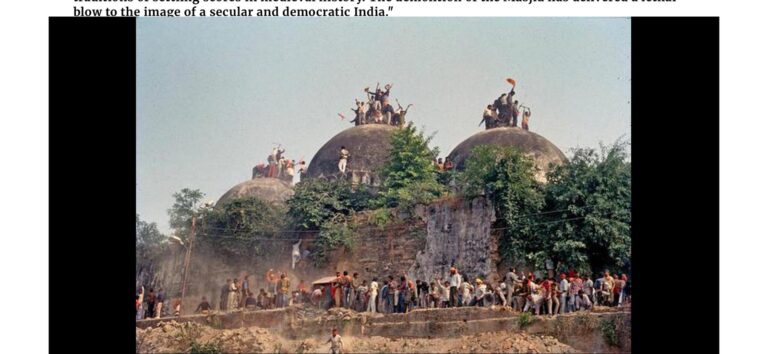
The demolition of the 450-year-old Babri Masjid on 6 December 1992 stands as one of the darkest moments in modern Indian history. What unfolded in Ayodhya—thousands of frenzied kar sevaks tearing down the mosque with unrestrained violence—was a chilling display of religious fanaticism at its ugliest. The barbaric destruction of the structure not only ignited nationwide communal riots, but also delivered a devastating blow to India’s image as a secular, democratic republic.
The events exposed the destructive mobilization engineered by the RSS, VHP, Bajrang Dal, and their political ally, the BJP, whose relentless rhetoric, mass rallies, and coded incitement created the conditions for mob hysteria. Despite later denials, the leadership of the movement played a central role in fostering the climate that made the demolition inevitable. The Hindutva campaign’s constant attacks on “pseudo-secularism,” accusations of minority appeasement, and inflammatory portrayals of history sowed division and legitimized majoritarian aggression.
Judicial Outcomes & Concerns of Bias
Nearly three decades later, the legal outcome of the Babri Masjid case has raised profound concerns about the state of India’s judiciary, prompting widespread criticism from legal scholars, civil society, and political observers.
1. Acquittal of Key Accused (2020)
A special CBI court acquitted all 32 accused, including senior BJP leaders:
L.K. Advani
Murli Manohar Joshi
Uma Bharti
The court ruled that there was “insufficient evidence” of a conspiracy—despite:
Extensive public speeches,
Mobilization drives,
Recorded planning meetings,
And the Supreme Court’s own 2019 judgment, which called the demolition an “egregious violation of the rule of law”.
2. Procedural Irregularities
Critics highlight several troubling legal irregularities:
1986: A district court unexpectedly ordered the opening of the mosque locks, enabling worship by Hindus—an action later deemed illegal by the Allahabad High Court.
Despite declaring it unlawful, the court refused to overturn subsequent proceedings arising from it.
These steps created a legal and political environment that benefited Hindutva groups.
3. Concerns About Judicial Independence
Scholars describe the Babri-related judgments as indicators of:
A perilous weakening of judicial impartiality
Selective justice on politically sensitive cases
Institutional susceptibility to majoritarian pressures
4. Denial of Victim Standing (2022)
In another controversial ruling, the Allahabad High Court dismissed a challenge to the acquittals, arguing that the Muslim litigants were “not victims” and therefore had no locus standi.
This left the community without any legal avenue for justice.
Final Verdict & Aftermath
In a historic and contentious decision (2019), the Supreme Court:
Awarded the entire disputed site to a Hindu trust for construction of a Ram temple.
Granted 5 acres of separate land elsewhere to the Sunni Waqf Board for a new mosque.
While the verdict formally ended decades of litigation, it left unresolved grievances:
A centuries-old mosque was illegally destroyed.
No individuals were held legally accountable.
The final outcome was widely perceived as legitimizing an act that the Court itself recognized as an unlawful, orchestrated attack.
For many, the saga symbolizes a painful truth: a blatant act of defiance of law went unpunished, deepening fears about the erosion of justice, equality, and secular governance in India.